Beyond GPUs? Researchers Propose New Computing Architecture to Cut AI Energy Use
Extropic Corp. and MIT researchers report a transistor-based probabilistic computing architecture targeting generative AI workloads.
Shane Barrett·updated July 05, 2026
Architecture and methodology
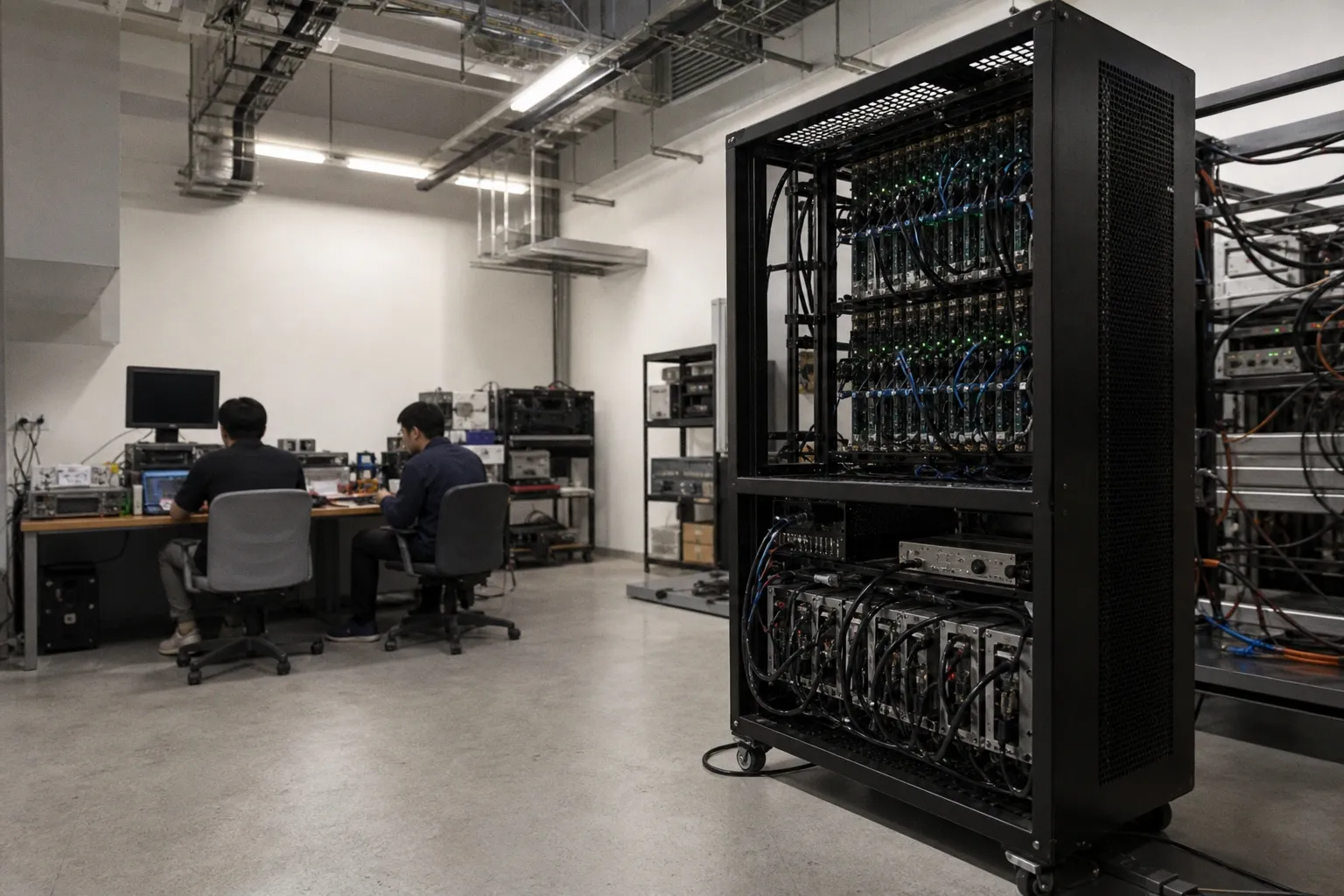
DTCA sits inside thermodynamic computing, a paradigm in which controlled stochasticity is integral to the computation rather than a numerical byproduct. The design relies on conventional CMOS transistors rather than specialized AI accelerators and is structured around Boltzmann machines—energy-based models that learn by assigning probabilities to configurations rather than producing a single output. The architecture adopts the iterative denoising logic of diffusion models to address a known failure mode of prior probabilistic systems: as earlier models grew more expressive, efficient sampling degraded and projected energy advantages eroded. By chaining denoising steps analogous to those in modern diffusion pipelines, the proposal attempts to keep the target distribution tractable at each stage.
Results and limitations
The reported 10,000× energy-per-sample figure rests on simulation combined with lab characterization of one component. The paper does not present a complete DTCA implementation. The comparison target is described as a simple image-generation benchmark, which constrains external validity. No throughput, latency, or output-quality measurements against state-of-the-art diffusion stacks are confirmed in available source material. The authors frame the GPU ecosystem as a "hardware lottery," arguing that algorithm design has co-evolved with accelerator strengths and that alternative substrates could unlock different—and more energy-efficient—algorithmic families. The paper explicitly states that AI-focused data center investment now exceeds the inflation-adjusted cost of the Apollo program.
What to verify
The motivation section cites projections that AI data centers may approach roughly 10% of U.S. electricity generation by 2030, contextualizing the hardware search. Readers tracking the work should examine: the exact benchmark and baseline used for the 10,000× estimate; whether silicon-level reproduction matches the simulated sampling efficiency; and whether end-to-end image-quality metrics are reported alongside energy figures in the full publication. Until a complete DTCA implementation is benchmarked against established diffusion stacks, the energy claim remains an upper-bound projection rather than a measured result. Follow-up questions include how the architecture handles non-image modalities, what the per-sample latency tradeoff is, and whether the Boltzmann-machine training pipeline scales with the denoising step count.