CoreWeave Unveils ARIA to Accelerate AI Research and Agent Development
CoreWeave has unveiled ARIA, described in the source headline as an effort to accelerate AI research and agent development. The available record does not yet provide architecture, benchmark, pricing, access, or deployment details.
Shane Barrett·updated July 03, 2026
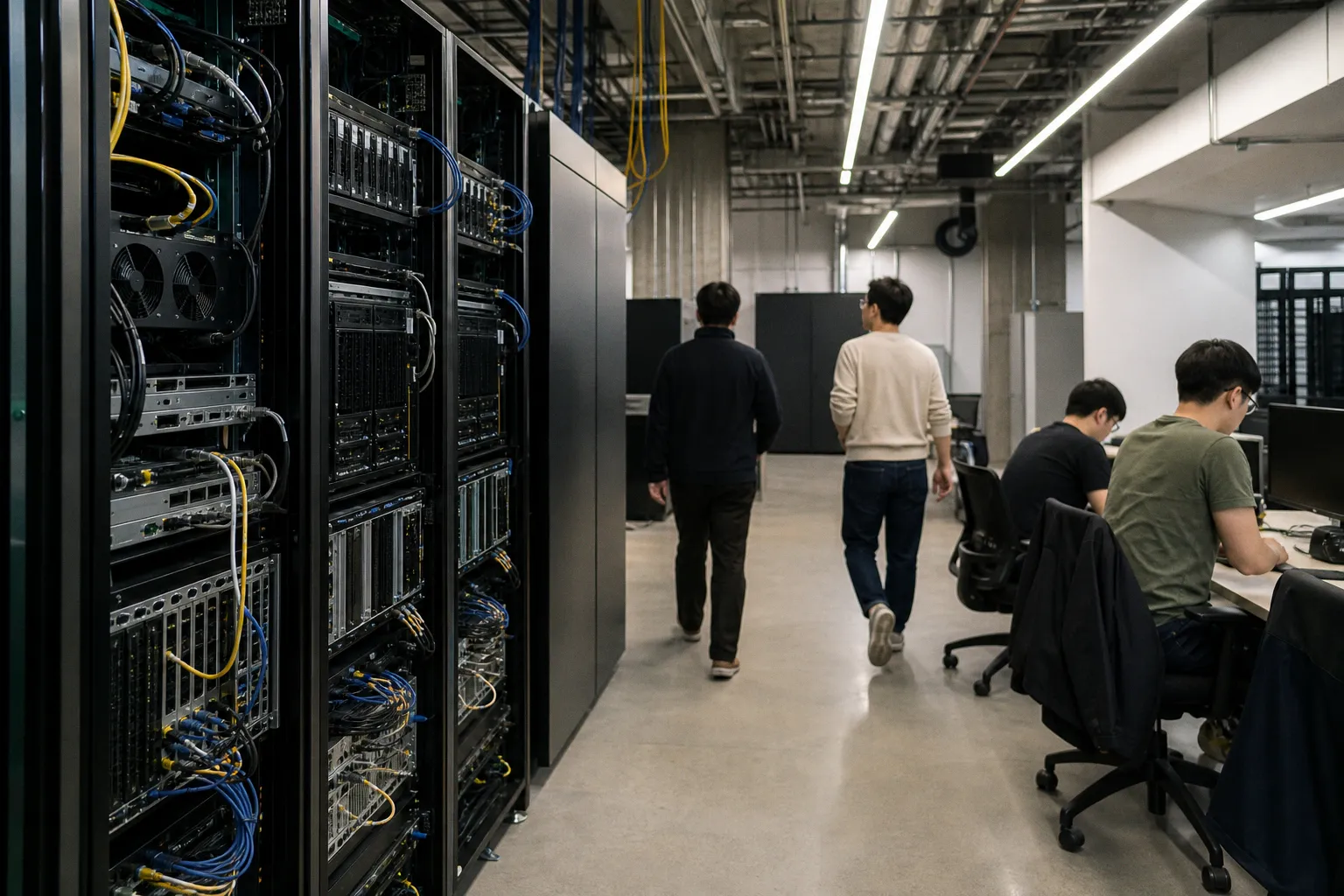
Agent infrastructure is becoming the workload, not the appendix
The CoreWeave item is reported by Yahoo Finance only at headline and snippet level in the available evidence. It states that CoreWeave unveiled ARIA to accelerate AI research and agent development. No source text is available here describing the system design, supported frameworks, scheduling model, hardware profile, latency characteristics, or reproducibility guarantees.
That absence matters. “Accelerate AI research” is not a measurable claim without workload definitions. For paperscode.org readers, the first audit target is not the launch language. It is the evaluation surface: whether ARIA exposes enough detail to compare against existing training, inference, evaluation, and agent-orchestration stacks.
Agent development is computationally uneven. It can involve long-context inference, tool invocation, sandboxed execution, multi-step evaluation, synthetic data generation, and repeated failure analysis. A useful platform must reduce computational overhead across that loop, not merely provision accelerators. Without ablation data, queueing behavior, cost-per-run data, or benchmark methodology, ARIA should be treated as an infrastructure hypothesis.
Benchmarks are under pressure from “economic value” claims
The timing aligns with a broader shift in AI research framing. A Yahoo Tech report says Meta’s newly appointed AI research chief, Dawn Song, described the next frontier as AI agents that are “economically valuable.” The same report says she emphasized real-world impact over benchmark scores and argued that agents should augment humans rather than replace them.
The report also cites Agents’ Last Exam, a benchmark from the University of California, Berkeley, designed to assess whether AI agents can complete more than 1,500 economically valuable tasks across 55 industries. That benchmark framing is relevant to ARIA only as context, not as validation. There is no evidence in the available material that CoreWeave’s ARIA has been tested on ALE or any comparable task suite.
This distinction is important. Agent benchmarks are not equivalent to model benchmarks. They evaluate policies over tool use, execution traces, error recovery, and task completion. The latent space of failure is wider. A model can score well on static tests and still fail when the environment changes, when tool calls are brittle, or when intermediate state is corrupted. Any platform claiming to accelerate agent development should disclose how it supports repeatable evaluation, trace capture, sandboxing, and regression testing.
What technical teams should verify before adoption
The practical checklist is short. First, determine whether ARIA is a managed research environment, an orchestration layer, a compute allocation product, or a broader agent development stack. The source material does not specify this. The distinction affects integration cost and parameter efficiency analysis.
Second, require executable evidence. Useful documentation would include reference implementations, reproducible benchmark scripts, failure-mode reporting, and clear comparison baselines. Marketing claims about acceleration are weak without controlled runs across model size, context length, task horizon, and tool-call frequency.
Third, evaluate whether the platform supports agent research as an experimental discipline. That means deterministic replay where possible, structured logs, environment versioning, task suites, and clear isolation between model behavior and infrastructure behavior. Otherwise, observed gains may reflect hidden scheduling advantages or benchmark leakage rather than durable architectural improvement.
A separate Aju Press item says South Korea is considering expanding overtime for AI research and development. With only the headline available, it should not be overread. It does, however, point to the same operational pressure visible in the CoreWeave and Meta-related items: AI research capacity is being treated as an execution bottleneck, not just a modeling problem.
For now, ARIA is a signal to monitor, not a result to cite. The next useful artifact would be technical documentation or a benchmarked implementation path. Until then, the correct posture is conservative: log the launch, withhold architectural judgment, and test only against reproducible agent workloads.