Machine learning datasets: why training volume is surging
Llama 3 moved from Llama 2’s 2 trillion training tokens to more than 15 trillion. That is not a routine dataset refresh.
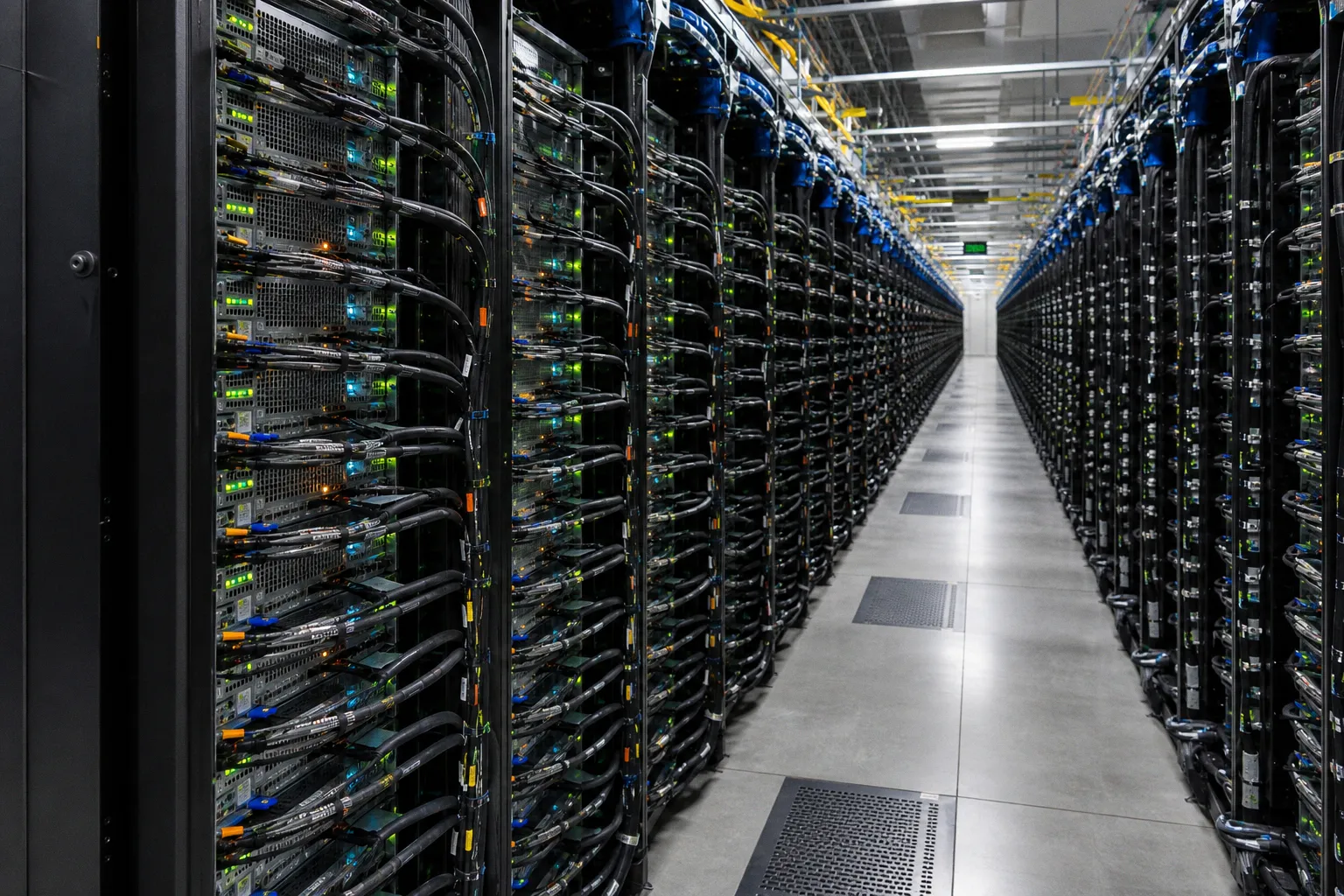
It is a sevenfold increase in the input side of the pipeline, with all the ugly consequences: more storage, more filtering, more deduplication, more provenance failures, and more opportunities to quietly train on garbage at GPU-cluster scale.
The easy explanation is that models need more data. It is also incomplete. Training volume is surging because the economics of deployed models changed. Teams are overtraining relatively compact models to improve quality while keeping inference latency and serving cost under control. At the same time, text-only corpora are no longer enough for frontier capabilities. Image-text pairs, video clips, OCR traces, UI interactions, code execution results, and synthetic trajectories are entering the same furnace.
The bottleneck is no longer downloading a web crawl. It is building a data system that can sustain throughput without turning dataset quality into technical debt.
Beyond Chinchilla: the new economics of overtraining
The 2022 Chinchilla result popularized a useful operating point: roughly 20 training tokens per parameter. In the clean-room version of scaling laws, that ratio makes sense. Compute is fixed. A model should not be too large for the available data, or too data-starved for its parameter count.
Production incentives changed the calculation.
An 8B-parameter model that has seen a deep, curated corpus can be much cheaper to serve than a much larger model trained closer to the old compute-optimal ratio. Lower memory pressure. Higher request throughput. Fewer GPUs per replica. Easier autoscaling. Better odds of meeting a real SLA without building a small power station behind the API gateway.
Llama 3’s 8B model is an obvious data point. Its reported token-to-parameter ratio reaches roughly 1,875:1, far above the 20:1 Chinchilla reference point. That is not evidence that every model should ingest absurd amounts of text. It is evidence that “optimal” depends on what is constrained. If training compute is available once, but inference runs every second for millions of requests, pushing more work into pretraining can be rational.
I have seen this trade in less glamorous systems work. You pay once to compact an index, precompute features, normalize records, or cache an expensive transform. The job takes longer. The serving path stops bleeding. Overtraining is the model-training equivalent, except the input pipeline becomes a distributed systems problem with a research-paper budget.
| Parameter | Compute-optimal training posture | Overtraining for deployment economics |
|---|---|---|
| Primary constraint | Total training FLOPs | Inference cost, latency, and model footprint |
| Data requirement | Moderate token volume relative to parameters | Very large, repeatedly filtered corpus |
| Serving model | Often larger for a given quality target | Smaller model pushed closer to its ceiling |
| Data pipeline burden | High, but bounded | Extreme: deduplication, quality scoring, source controls |
| Main failure mode | Undertraining or oversized parameters | Contamination, low-value repetition, hidden data drift |
This is why dataset size trends cannot be read as a simple race for bigger numbers. Fifteen trillion tokens do not automatically beat two trillion tokens. If the extra 13 trillion are duplicated boilerplate, translated spam, malformed markup, and synthetic text generated from the same narrow distribution, the pipeline has merely purchased a larger bill and a slower incident review.
Training volume is now an inference-cost optimization. The dataset is part of the serving architecture, even though it never ships with the container.
The open-source dataset volume makes this dynamic visible, but the same logic applies to proprietary stacks. A compact model with strong pretraining is attractive because it can fit practical latency and unit-economics targets. The data team inherits the cost. Naturally.
The multimodal explosion: text is no longer the dominant unit
Text tokens are convenient to count. They are also increasingly misleading as a measure of dataset scale.
Multimodal training data changes the storage and preprocessing profile immediately. A text corpus is already messy, but at least its core unit can often be normalized into token sequences plus metadata. Image, audio, video, documents, UI traces, and paired annotations create several data planes at once:
- Raw media objects need durable storage, checksums, access controls, and content-addressable deduplication.
- Derived representations need to be reproducible: resized images, extracted frames, OCR output, audio transcripts, embeddings, and tokenized captions.
- Pairing quality matters as much as sample quality. A high-resolution image matched to a wrong caption is not a minor labeling defect. It is a poisoned supervision signal.
- Safety and licensing policies must follow every derivative artifact. Dropping the original URL after feature extraction does not make provenance disappear.
- Sampling has to balance modalities. A training run flooded with low-value web images can weaken language or reasoning behavior even if the headline dataset count looks impressive.
LAION-5B illustrates the scale. The dataset contains 5.85 billion image-text pairs and became a major ingredient in the training ecosystem for image-generation systems, including Stable Diffusion. The point is not that every team should mirror LAION. Most should not. The point is that multi-billion-pair datasets made multimodal scale operationally normal, and the rest of the stack had to catch up.
Video makes the arithmetic worse. One image-caption pair is a bounded object. A video sample carries temporal structure, frame selection, audio alignment, subtitle quality, scene transitions, and often a long-tail of policy-sensitive material. Store all frames and your object store expands fast. Sample frames aggressively and you risk deleting the action that provides the label. Run expensive vision encoders offline and you have another compute fleet to schedule. Skip the validation pass and corrupted or mismatched assets enter training unnoticed.
I do not treat multimodal datasets as “a dataset plus files.” They are data products with an ingestion SLA. If a team cannot answer which version of a captioner, OCR system, deduplicator, and safety classifier produced a record, it cannot reliably reproduce a model run. It can only rerun something and hope.
The macro pressure behind this buildout is not confined to ML labs. The policy and IP competition around model inputs has become part of the infrastructure landscape, much as China’s record patent growth is shifting the fintech balance in adjacent technology markets. Dataset access, ownership, and reuse rules are no longer back-office details.
The data wall is a quality problem before it is a quantity problem
Estimates place the total stock of high-quality human-generated public text at roughly 300 trillion tokens. That sounds large until it is compared with current consumption rates, repeated training cycles, and the fact that “available on the web” is not the same as “usable in a training run.”
Epoch AI’s analysis puts the likely exhaustion window for high-quality public human text between 2026 and 2032 under current trends. Treat that as a planning horizon, not a doomsday clock. Data will not vanish on a Tuesday morning because somebody reached token 300,000,000,000,001. But the marginal cost of acquiring clean, legally usable, diverse, and non-redundant human material is rising.
Between 2023 and 2024, an estimated 5% to 25% of high-quality web data became restricted from major AI crawlers. That restriction can come from crawler blocks, licensing changes, publisher decisions, privacy concerns, or terms that make reuse commercially unsafe. The practical result is fewer low-friction sources for the exact data category everyone wants.
The industry response has three tracks.
1. Extract more value from existing corpora. Better deduplication, document-quality scoring, domain balancing, language identification, and benchmark contamination controls can make a fixed corpus more useful. This is not glamorous. It works.
2. Use data more efficiently. Architectural changes, better objectives, retrieval, tool use, and inference-time compute reduce the assumption that every quality gain must come from another trillion pretraining tokens. Reasoning systems that spend more computation at inference are one alternative path. Not free. Just a different bill.
3. Generate new training material. Synthetic data growth is the obvious response, particularly where ground truth can be verified through a simulator, compiler, database, formal checker, or structured business rule.
The third track gets the headlines because the market numbers are large. Forecasts put synthetic-data-market growth around 35.3% to 46.2% annually through 2030, with valuations above $1.7 billion. Gartner predicted in 2024 that synthetic data could account for 60% of data used in AI development. Those figures describe momentum, not reliability.
Synthetic output is not a 1:1 substitute for human experience. It inherits blind spots from its generating models and prompts. Train repeatedly on narrow synthetic distributions and the model can lose coverage of rare phrasing, unusual reasoning patterns, minority languages, evolving cultural context, and edge-case facts. In the worst case, quality degradation becomes self-reinforcing. The industry calls this model collapse. The exact long-term impact at frontier scale remains unsettled. Anyone claiming the risk is solved is selling a dashboard.
Automated curation is now a model pipeline
At 15 trillion tokens, manual review is not a strategy. It is a press release waiting for a postmortem.
The operational shift is toward automated curation systems: classifiers, heuristic filters, deduplicators, language and domain detectors, safety filters, and sampling policies running as a staged pipeline. Meta reported using Llama 2 to help build text-quality classifiers for the Llama 3 training corpus, alongside heuristic and NSFW filtering. That approach is increasingly standard in principle: use models to decide which data should train later models.
This creates a recursive system. It can be effective. It also has sharp edges.
A classifier optimized to reject obvious spam may accidentally remove informal writing, low-resource languages, dialects, niche technical discussions, or legitimate adult-context material needed for safety behavior. A near-duplicate filter may eliminate valuable repetitions in code, legal documents, or scientific notation. A source-level rule may discard entire domains because the early samples looked bad. Each decision changes the training distribution.
The curation stack therefore needs observability. Not hand-waving about “clean data.” Actual measurements.
What I would instrument before scaling the corpus
- Acceptance rate by source, language, domain, and document length. A sudden collapse can signal a broken parser or an over-tuned quality model, not improved cleanliness.
- Exact and near-duplicate rates before and after filtering. Deduplication must be measured by content category. One global threshold is how useful code corpora get accidentally shredded.
- Classifier disagreement. When a heuristic filter, a learned quality model, and a safety classifier disagree, those samples are where human audit capacity earns its keep.
- Dataset-version lineage. Every retained record needs traceable source metadata, transformation version, filter decisions, and split assignment. Without lineage, contamination investigations become archaeology.
- Training-sample mix over time. Token totals are insufficient. Track proportions by domain, language, modality, source class, quality bucket, and synthetic-versus-human origin.
- Holdout contamination signals. Benchmark examples, evaluation prompts, and derivatives must be blocked before final mixture assembly. Finding leakage after a launch is expensive and embarrassing.
There is a throughput trap here. Teams often centralize all curation in one heavyweight service, then discover that embedding, classification, and media transforms cannot keep up with raw ingestion. The backlog grows. Engineers bypass stages “temporarily.” Temporary becomes a permanent unversioned path into the training bucket.
I prefer immutable raw storage, append-only metadata, and separately versioned derived datasets. It costs more upfront. It is cheaper than retraining because an OCR update silently changed document text, or because a new URL canonicalizer doubled the apparent uniqueness of the crawl.
At trillion-token scale, curation is not a preprocessing script. It is a production service with failure domains, backlog management, and audit logs.
The same applies to weak supervision. Programmatic labels can expand coverage dramatically, especially in domain-specific classification or document extraction. But label functions are software. They need tests, versioning, disagreement analysis, and rollback paths. If the labeling pipeline cannot be rolled back, it is not automation. It is a source of irreversible noise.
Synthetic data pipelines: useful, expensive, and easy to misuse
Synthetic data is most credible where its correctness can be checked independently. Code generation is the clean example: generate a task, generate a candidate solution, compile it, run tests, execute property checks, retain verified traces. Math can use symbolic or numerical verifiers for portions of the workload. Agent trajectories can be replayed in a controlled environment. Tabular records can be generated under explicit constraints and validated against schema rules.
That is materially different from asking a model to invent realistic customer conversations and then using another model to rate them. The second pattern can still have value, but it is much closer to a feedback loop. There may be no external ground truth, only consensus among systems trained on overlapping material.
A synthetic data pipeline that deserves production budget has four properties:
1. A targeted deficit. It fills a measured gap: rare API failures, multilingual support patterns, underrepresented document templates, difficult tool-use paths. “We need more synthetic data” is not a deficit definition.
2. An independent validator. Compilers, simulators, deterministic rules, retrieval-backed checks, human review, or held-out real-world outcomes should reject bad samples. Generator-as-judge is weak evidence.
3. Mixture controls. Synthetic records need explicit quotas and sampling weights. They should not flood human-origin data simply because generation is cheap and the object store is empty.
4. Evaluation on non-synthetic holdouts. If the benchmark is generated by the same pipeline, the score mainly measures alignment with the pipeline. That is not a deployment metric.
There is a practical cost model, too. Synthetic data does not eliminate compute demand. It moves it earlier in the chain. A serious pipeline may need generation models, judges, dedupe passes, embedding jobs, validators, storage for rejected samples, and human audits. Add retries and rate limits. Then add the inevitable OOM event from batching long contexts with media attachments. The cost can still be justified, but it must be counted.
For a smaller team, the sensible starting point is narrow. Generate data only for failure modes that already appear in evaluation or production logs. Validate it with something stronger than model self-approval. Run an ablation against the same model trained without the synthetic tranche. If downstream quality, calibration, or robustness does not improve on real holdouts, discard the pipeline. Do not preserve it because the demo looked productive.
Dataset scale is becoming an infrastructure decision
Machine learning datasets are surging because training is no longer isolated from deployment. Bigger and better-curated corpora can let smaller models deliver acceptable quality at lower serving cost. Multimodal systems multiply the number and type of training objects. Public human text is becoming more constrained. Synthetic generation is filling gaps, but it creates fresh reliability work rather than removing it.
The winning data stack will not be the one with the highest token count in a launch post. It will be the one that can ingest heterogeneous inputs, preserve provenance, filter aggressively without flattening diversity, generate verifiable synthetic examples, and reproduce a training mixture six months later under pressure.
My deploy-or-discard test is blunt. Scale a dataset only when its added volume improves a real quality metric, lowers serving cost, or expands capability on a held-out workload. If it merely makes the corpus number bigger, it is not an asset. It is storage, compute, and technical debt wearing a benchmark badge.